
Amid the rapid technological advancements that organizations are experiencing today, many might assume that physical identification has lost relevance compared to digital solutions. However, daily operations in companies, universities, hospitals, industries, and public entities demonstrate the opposite: identification—both physical and digital—remains the primary security filter and the non-negotiable foundation of organizational trust.
The most common mistake when structuring a security program is to think exclusively of the card as the starting point. Technically, a credential should be understood as an authentication and authorization tool that securely and unambiguously links a user’s identity to a specific set of permissions. Its function is to validate that the bearer is who they claim to be, in order to grant them the right to interact with an environment.
Thinking about credentials is valuable, but if we limit ourselves to what’s visible, the system will be vulnerable. To structure truly functional projects, security experts use the “Identification Iceberg” concept. This model demonstrates that the ideal credential isn’t the starting point, but rather the end result of defining three pillars hidden beneath the surface.
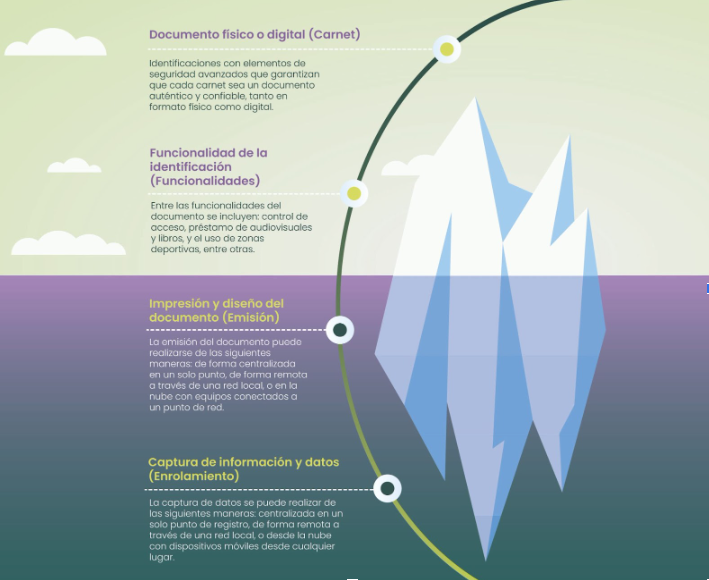
The Depths of the Iceberg: The Three Structural Pillars
For identification to be the driving force behind corporate security, it is imperative to establish the following operational foundations before printing the first card:
- The deep foundation: enrollment and identity validation
The registration and validation process is the most critical part of the iceberg. This pillar defines how biographical and biometric data is captured, or how it is integrated from existing corporate sources such as Active Directory, ERP, or Human Resources systems.
If identity isn’t rigorously verified from the outset, any subsequent technology—no matter how advanced—loses effectiveness. Modern cybersecurity models, such as Zero Trust, are based on a clear principle: identity is the new perimeter. Therefore, poor capture or validation compromises the entire security framework from day one.
Depending on the type of credential, enrollment takes different forms:
- Physical enrollment (centralized and in-person): This is the traditional and standard model in critical infrastructure such as banks, airports, or government entities. The user goes to a registration station where their documents are validated, a live photograph is taken, and biometrics (fingerprint, face, or iris) are captured and securely associated with their physical credential.
- Digital Enrollment (Decentralized and Remote): Allows users to complete their registration from their smartphone, without having to travel. It combines document validation (OCR) with selfies and liveness verification to prevent identity theft. Once identity is verified, the organization can issue the digital credential even before the person physically enters the premises.
- Hybrid enrollment (the convergent ecosystem): Integrates the physical and digital under a single data source. The user registers only once—for example, through remote pre-registration—and this validation enables both their digital and physical credentials. One process, multiple identification formats, greater efficiency and control.
The support structure: Secure issuance and provisioning
One level higher is logistics: how will the credential reach the user securely? Currently, issuing credentials is no longer limited to printing a plastic card; it involves managing the entire identity lifecycle across different formats (physical, digital, or hybrid). Defining this process is vital, as provisioning without robust protocols represents a critical internal vulnerability.
- Issuance of physical credentials: This requires defining whether the model will be centralized (high-volume production from a main office with logistical distribution) or decentralized (immediate printing at branches). Here, the quality of the materials and the integration of high-security forensic elements (holograms, UV inks, microtext, and special laminates) that mitigate the risk of physical counterfeiting come into play.
- Digital credential provisioning: Issuance is transformed into an Over-The-Air (OTA) process. This involves the secure delivery of links, one-time codes, or encrypted emails so the user can download their credential directly to their mobile device (via native app or corporate wallets ). Security here relies on channel encryption and the ability to revoke the digital credential in milliseconds if the device is lost or the employee is deactivated.
- The hybrid model: Many organizations issue a “digital twin.” The user receives a physical card with visual security features to wear on the premises, and simultaneously, a mobile credential is provided on their smartphone. The challenge here is to keep both credentials synchronized under the same database, ensuring that if one is canceled, the other is also canceled.
Underwater: Integrated technology and functionalities according to the use case
Before the credential is displayed, it’s essential to define its functions and the most suitable format for each environment. The underlying technology—whether a physical chip or a smartphone protocol—determines its operational scope: access control, computer login, internal payments, or time and attendance management.
The decision does not depend on the trend, but on the use case and the specific needs of the organization.
- The power of the physical environment (RFID chips/smart cards): Physical credentials, based on technologies such as MIFARE, DESFire, or iCLASS, remain essential in environments where mobile phone use is restricted or impractical. This is the case in manufacturing plants, sterile hospital areas, or mining environments. Furthermore, since they do not rely on batteries, they guarantee constant availability and continuous 24/7 access.
- The agility of the digital environment (NFC, Bluetooth, and dynamic QR codes): Mobile credentials use Bluetooth Low Energy (BLE) or NFC on smartphones to open doors even from several meters away (ideal for parking garages). They also incorporate technologies such as dynamic QR codes that change every few seconds and work offline , making it impossible for a user to send a screenshot to a third party to impersonate them.
- Hybrid convergence: The most robust projects integrate physical and digital credentials under a single architecture. An employee can use their smartphone for everyday access and their physical card for critical areas or device authentication. The format changes; the essential element is that identity is validated and centralized in a single system.
The surface: The visible credential
Only when the three previous pillars are resolved does the tip of the iceberg emerge: the visible physical or digital document. Name, photograph, position, and institutional logo. This surface layer allows for quick visual identification, but it serves a representational function, not absolute protection. Relying solely on this visual layer opens the door to impersonation.
The true value of this iceberg model lies in its adaptability to critical environments:
- Corporate sector: Allows segmenting access by hierarchy, reducing the risk of insider threats.
- Education: Transforming ID cards into a multifunctional ecosystem for libraries, laboratories, and payments.
- Health and industry: Controls entry to sterile or high-risk areas, validating in real time that the carrier has the necessary certifications.
The global trend is not to replace the physical with the digital, but rather to consolidate a hybrid model. Today, a physical credential is linked to a digital profile through multi-factor authentication (MFA) schemes, strengthening security without sacrificing the tangibility necessary for in-person control.
Talking about modern identification means talking about processes, technology, and rigorous identity management. Organizations that understand the magnitude of this “invisible iceberg” don’t invest in simple cards, but in comprehensive architectures that protect people, assets, and information, thus ensuring business continuity.