
At a bank with conversational AI, there are no lines, unnecessary repetitions, or endless waits: a virtual assistant calls you by name, understands your needs in seconds, and resolves 80% of your requests without human intervention.
These solutions can reduce operating costs by up to 85%, increase digital transactions by 160%, and triple the number of active customers on online channels. Furthermore, according to McKinsey, banks that implement conversational AI can reduce customer service costs by 20% to 30%, significantly improving customer satisfaction. This operational efficiency isn’t intended to replace human resources, but rather to empower them, allowing them to focus on specialized tasks where their contribution is irreplaceable.
Conversational AI: From a technological promise to a global transformative force
In just a few years, conversational AI has gone from being an emerging innovation to becoming a silent engine redefining the relationship between organizations and users around the world. Its evolution has been driven by advances in natural language processing, deep learning, and multi-channel capabilities, allowing it to understand, respond, and act with precision previously reserved for human interaction. Market growth reflects this acceleration: in banking, it already moves more than USD 13.6 billion and is projected to exceed USD 150 billion in less than a decade.
This advancement is no coincidence: it combines technological maturity with a growing demand for more agile, personalized, and 24/7 experiences, marking a turning point in the way we interact with services.
Banking: from basic chatbot to 24/7 financial advisor
In 2023, Ficohsa integrated a single virtual assistant into WhatsApp, Facebook, and X, capable of managing payments, transfers, and product inquiries in real time. The impact was overwhelming: more than 200% growth in active digital customers, a 160% increase in transactions, and 25 new features that expanded the user experience.
Now imagine a bank where AI not only responds, but also analyzes your financial profile, recommends the best savings or investment plan, and even initiates the process for you. According to BBVA Research , this personalization is key to customer loyalty and increasing product adoption.
Government: procedures without lines and with zero paperwork
According to GovInsider, countries like Estonia and Uruguay have proven that digitizing the relationship between citizens and the state can save millions in administrative management. Conversational AI takes this concept further: it allows users to renew driver’s licenses, pay taxes, or apply for subsidies through a single channel, without having to repeatedly repeat data.
In critical situations, such as floods or earthquakes, these assistants can become a vital channel of information, providing real-time evacuation routes, the location of aid centers, and the status of assistance requests.
Health: A digital medical assistant
According to McKinsey, digitalization in the healthcare sector has the potential to reduce hospital costs by up to 20%. A conversational assistant can become a patient’s first point of contact: scheduling appointments, sending reminders, providing guidance during initial triage, and delivering laboratory results, all under strict safety protocols and without replacing professional medical care.
Retail and Telcos: the customer is king
In retail, conversational AI boosts the customer experience by allowing them to track orders, manage returns, and receive personalized offers based on their purchase history. According to Juniper Research, this technology could generate more than $290 billion in additional retail sales by 2025. In telecommunications, self-service sales already make it possible to create customized plans, renew devices, and activate services without calling a call center, reducing operational burden by up to 40% and speeding up service times by more than 60%, according to Deloitte.
Conversational AI: The assistant that never sleeps and always sells
Conversational AI is redefining the relationship between companies and customers with benefits that directly impact business. It offers personalized experiences 24/7, remembering each user’s history to respond with context and precision. Its immediate scalability allows serving thousands of people simultaneously without increasing staff, while omnichannel interaction ensures seamless support across WhatsApp, the web, social media, or apps, all with a single assistant. Furthermore, Gartner projects that by 2026, 75% of customer service interactions will be managed by AI.
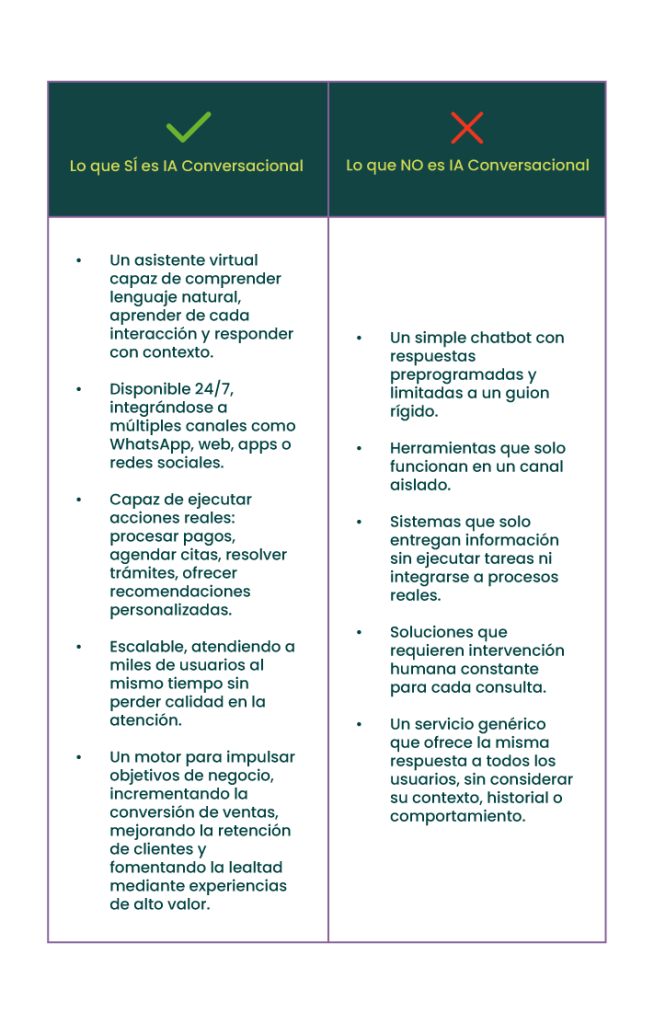
Conversational AI is no longer a luxury: it’s the new standard for organizations seeking agility, profitability, and closeness to their users. A single intelligent channel centralizes attention, automates processes, and amplifies responsiveness, becoming a key driver of experience and competitiveness in the digital age.
And this is just the beginning: today, a conversational AI assistant can solve tasks on its own; tomorrow, it will act as an orchestra conductor, coordinating multiple artificial intelligences in a collaborative ecosystem capable of addressing deeper needs and delivering customer value seamlessly.